- Market cap
- Revenue
- Net income
- Cash on hand
- Gross margin
- Net margin
- EPS
- P/E ratio
We invite you to check out this Consumer Education Video Series narrated by MWC’s Assistant Director of Production, Mark Theiler. Learn about everything from The Treatment Process to Understanding Changing Drinking Water Regulations. The Treatment Process: A Multi-Step Approach to Producing Safe Drinking Water Understanding Changing Drinking Water Regulations The Safe Drinking Water Act: Why it’s Important! The Capital and Operating Costs of Providing Safe Water
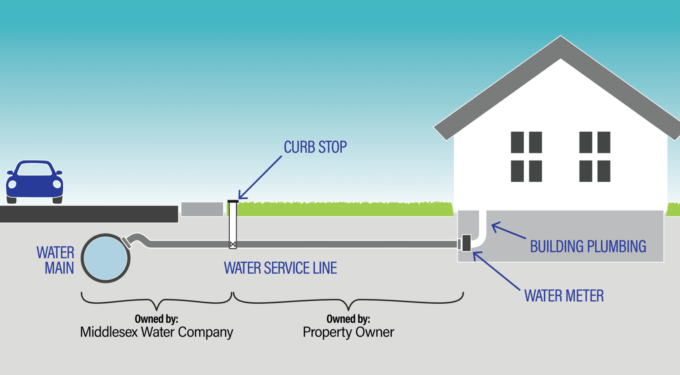
Protect Your Household by Reporting the Composition of Your Water Service Line Water delivered to your tap by Middlesex Water is lead free and the Company adds further treatment to minimize lead that may be in household pipes from leaching into the water. The company-owned portion of the water service line – the line taking water from the street to the curb stop – is also lead free. But, if the customer-owned portion has lead, it can leach from the pipe into the treated drinking water entering customers’ homes. Lead solder in indoor plumbing and lead in some older plumbing fixtures can also add lead to drinking water. Confused about the location of your service line? The illustrations below may reflect your service line configuration. Lead can pose a health risk, particularly to young children, pregnant women, and unborn babies. Lead can build up in the body over many years and can cause damage to the brain, red blood cells, and kidneys. So, it’s important for customers to know if the service line providing water to their home and family is made of lead. The good news for New Jersey residents is that legislation enacted July 22, 2021, calls for utilities to replace the entire length of the lead service line from the water main in the street to the water meter on the home or building owner’s property within a 10-year period at no direct cost to the property owner. Middlesex Water has already replaced any known utility-owned lead service lines but because it does not have records on the service lines owned by customers on their private property, it is asking customers to self-report the composition of their service line through its web portal. Instructions are provided on how customers can assess and submit their service line assessment. Once the Company has an accurate inventory of customer lead lines, it can begin to develop a schedule to systematically and methodically replace any customer-owned lead lines serving their home. The success of our Knocking Out Lead program – and improving our community’s health – relies on the cooperation of property owners to learn more and report their service line material. The Company has long been working with communities to reduce lead exposure. As part of its treatment process, the company uses pH control and further adjusts the water chemistry to minimize lead dissolving into water. Middlesex tests water every six months in at least 100 high-risk homes in the distribution system, in compliance with state and federal requirements. The test results have never been above the U.S. Environmental Protection Agency’s (EPA) lead or copper action levels per the Lead and Copper Rule. Additionally, regulations now also require New Jersey utilities to replace galvanized steel service lines, in addition to any lead lines, and Middlesex is currently replacing those lines on both the utility-owned and customer-owned portion. Fighting lead requires a united effort. We encourage all customers to join in our mission of "Knocking Out Lead” by visiting our Lead education page and submitting their service line status. Report your service line composition here. To learn more about health effects of lead and how to reduce exposure, review the FAQs and the following additional resources: https://youtu.be/PqFHrae92OM <a href=
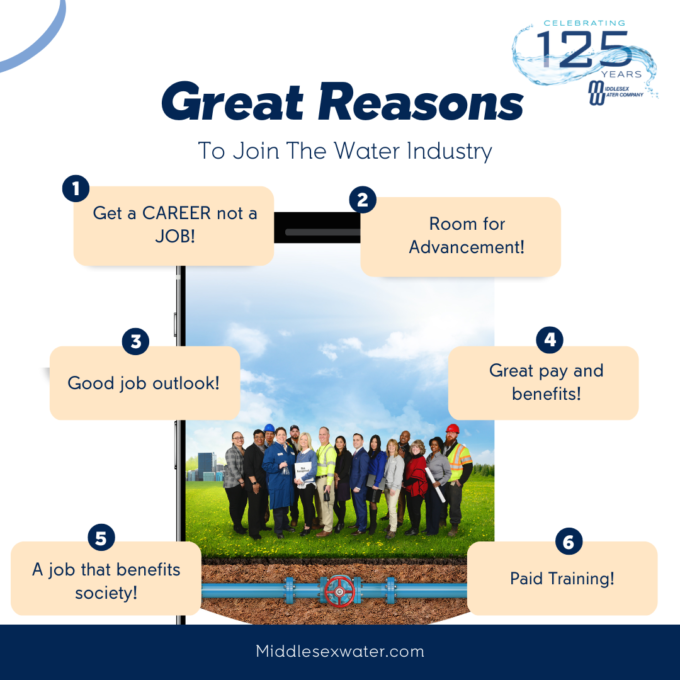
Water, it’s absolutely essential to everyday life. And so too are the individuals who work behind the scenes to deliver clean, safe, affordable water supplies. Have you ever considered a career in water? Here are five reasons that might serve to whet your appetite for a career in the water and wastewater industry: Not Just a Job, but a Fulfilling Career! Working in the water and wastewater field offers vast opportunities for growth and development as well as competitive pay, health benefits and flexibility. Paid holidays and vacations also make working in water enticing. Many positions allow you to work independently in the field, while having the support of a team to assist in day-to-day operations. Providing clean water 24/7, 365 days a year, maintaining the integrity of utility assets, complying with regulations and efficiently managing and delivering water through investments in infrastructure presents numerous challenges and, as such, requires an integrated approach. For that reason, strong teamwork, shared best practices and collaboration abounds in this industry. The Chance to Learn New Skills Technology in the water industry is constantly evolving so you are continually learning and mastering new skills and creative approaches. Many positions offer on-the-job training and talented personnel are encouraged to grow their technical skills with continuing education, additional licensing and certifications. This helps advance your career and positions you for opportunities for greater income potential. Since water and wastewater systems can be found across the country, numerous opportunities abound in this field for talented and qualified personnel. Opportunities such as internships and apprenticeships can often be found in the water and wastewater field as well as mentoring partnerships. An Industry Where Professionals are in Demand…Everyone Needs Water! The very nature of the water and wastewater industry makes workers essential. Think about how many times you use water in your everyday life. While every industry and job faced obstacles in the height of the COVID-19 pandemic, the water industry was not subject to as much volatility. Lab personnel continued to ensure drinking water quality, field personnel continued to repair water mains and customer service personnel remained responsive to customer needs. Working in the water and wastewater field generally offers more stability than in other sectors. But there is more. Aging infrastructure coupled with an aging workforce is creating more opportunity. Utilities will need to invest more capital to upgrade facilities to comply with emerging regulations and new legislation. This requires ongoing training and development of utility personnel. Many experienced professionals in these fields are expected to retire in the next decade. That’s a lot of institutional knowledge that will need to be captured by new and talented workers. As utilities work to continually upgrade and improve their water and wastewater systems, personnel will need to continually learn and expand their knowledge and skill set. You’re Helping to Protect and Preserve one of Nature’s Most Precious Resources! Water is a finite resource. Water professionals work to manage watersheds, preserve water resources and ensure water gets delivered safely and efficiently. This is a field with purpose that’s integral to environmental sustainability. When you work in water, you know your efforts are making an impact on your community and the environme
In July 2021, New Jersey enacted a new law (P.L 2021, c.183) requiring all public community water systems to inventory and replace all known lead or galvanized steel service lines by 2031. Middlesex Water is pleased to join this statewide initiative focused on reducing lead in drinking water and improving public health. How Does Lead Get into Drinking Water? Most lead exposure comes from contaminated soil, dust, or paint chips. However, while rarely found in water leaving a treatment plant or traveling through a water main in a water provider’s distribution system, lead can sometimes be found in drinking water. Lead can dissolve into water as it comes in contact with lead containing materials such as a pipe known as a “service line” and plumbing fixtures inside a building. But a robust Corrosion Control Program, such as the one used by Middlesex Water, will minimize the amount of lead released. In addition to producing an inventory of “known” lead or galvanized steel service lines within the distribution system, water systems will also be required to identify and address all service lines whose material composition is unknown by July 2031. In most cases, a service line contains two portions, a Company owned-portion (typically from the water main in the street to the curb stop typically at the property line or sidewalk) and a customer-owned portion (from the curb stop to the meter inside the home). At Middlesex Water, we’re eager to comply with this new requirement and announced our Lead Service Line Replacement Program in mid-February 2022. We have posted our service line inventory on our website where customers can view the composition of their service line. In addition, we also mailed certified notices in February 2022 to those customers whose service lines may contain lead or galvanized pipe. Generally, homes constructed before 1988, may contain lead or galvanized service lines. There is less of a likelihood of lead or galvanized steel service lines in homes constructed after 1988. Reducing Lead Exposure Middlesex Water has long taken steps to protect its customers from lead exposure. Middlesex Water replaced all of the company-owned lead service lines more than 30 years ago with the onset of the U.S. Environmental Protection Agency’s (USEPA) Lead and Copper Rule. We are now shifting our focus to replacing any known galvanized steel lines and lead goosenecks (a small connecting pipe) on the company-owned portion of the service lines, as per the new rules. Middlesex Water has had a long-standing Corrosion Control Program which helps control the pH level in the water. The pH level impacts the corrosivity of water. A corrosion control chemical, zinc orthophosphate, is used as part of the normal water treatment process. Zinc orthophosphate coats the inside of the service lines, helping to minimize the amount of lead which could potentially dissolve into the water. Lead sampling and testing is conducted every six months in compliance with state and federal regulations. The Lead and Copper Rule is a component of the federal Safe Drinking Water Act which is administered by the USEPA by authorization of Congress. Middlesex Water has never exceeded the lead or copper action levels set by the Lead and Copper Rule. A Shared Responsibility between Customer and the Company Mi
Where’s the Fairness in “Fair Market Value?” Artificially Inflated System Valuations Will Cost Ratepayers Even More PEGGY GALLOS, DENNIS W. DOLL | JULY 23, 2021 | OPINION As the co-authors of this article, we disagree concerning the costs and benefits of private versus public ownership and operation of water and wastewater utilities. The emergence, however, of the so-called “Fair Market Value” approach to determining the value of a public utility, and its detrimental impact in our view on both the ratemaking authority of the New Jersey Board of Public Utilities (NJBPU) and ultimately customers, is so concerning that despite our different views, we are aligned in our opposition to this approach, which in recent years has gained, and continues to gain, traction in New Jersey. Some context - New Jersey’s Water Infrastructure Protection Act (WIPA) was enacted in 2015 and allows municipal water and wastewater utilities to enter into a long-term lease or outright sale of the utility assets to a capable owner and operator of a private (investor-owned), or public (government-owned) utility system. WIPA eliminated the requirement for a public referendum for the lease or sale of a municipal utility system if one of five “emergent conditions” is met, as certified by the New Jersey Department of Environmental Protection. WIPA is a version of so-called “Fair Market Value (FMV)” legislation. This legislation allows non-traditional methods for valuing utility systems which artificially inflates the value of these systems to the detriment of customers. FMV legislation has been enacted in some form in recent years in numerous states around the country and it merits closer review from the lens of the customer. As FMV legislation has emerged in more states, it has received increased scrutiny from legislators, consumer advocates and others as the true financial impact of these transactions on utility customers is becoming more widely understood. WIPA, in particular, comes with serious consequences for utility regulators and for utility customers themselves. The law limits regulators’ ability to set traditionally just and reasonable rates and that, in turn, means potentially higher costs for the utility customers themselves. Public entities sell their utilities for a variety of reasons. Some have to do with the utility itself, and they are all pretty standard. Selling is seen as a way to address 1) a need for significant investment in aging utility infrastructure, 2) compliance with current and anticipated water quality laws and regulations and other operational needs, 3) an aging workforce and the need for qualified employees and/or 4) mounting costly regulatory violations. Elected leaders may be unwilling to commit to managing and funding their utility because they lack the political “courage” to take the necessary steps to fund these challenges or because they simply don’t know they can pursue other approaches. Well-managed, well-funded utilities can also be sold because elected leaders who control them want to use the infusions of cash that come with these transactions to address other, more visible non-utility needs such as roads, municipal facilities, or pension funding. They may wish to eliminate municipal debt. Monetizing the utility assets may be an attractive solution to avoid dramatic increases in the near term in user fees or property taxes, which may be politically unpalatable. So where does FMV come into the picture? Take the case of an acquisition of a publicly-owned system by a private entity. The NJBPU regulates and approves the rates charged to customers of privately-owned utilities under a “regulatory compact” which balances the needs of both the customers and the privately-owned ut
Attention Delaware Residents: Do acronyms such as H2O, Cl2, WTP and CCR only serve to confuse and overwhelm you? You’re not alone. These acronyms are simply abbreviations for terms commonly used in the water industry, and stand for water, chlorine, water treatment plant and consumer confidence report, respectively. Oftentimes, jargon used outside of the industry is not well understood, which is why some consumers may be compelled to disregard information if it appears to be too complicated. As a property owner of real estate, you may periodically receive a letter from Middlesex Water Company affiliate, Tidewater Utilities (TUI) in reference to a Certificate of Public Convenience and Necessity (CPCN). Take a moment to understand the value of the often misinterpreted CPCN program. While not specific to the water industry, the history of CPCN’s date back to the late 1800’s when they were first developed to prevent duplication of services, protect investments through rate regulation and balance the social and organizational goals of society. They also helped to manage competition, and avoid the targeting of specific customers based on their geography. To summarize, the goal of a CPCN program is to make services accessible to the public in a fair and equitable manner for all parties. In order for TUI to supply water to a property, it must first be granted the water rights to serve that property by the governing regulatory agency. The agency will only approve the right to serve each parcel to one organization, giving the grantor the legal right to serve in perpetuity, unless a petition to withdraw is presented and approved. Who Does a CPCN Affect? If you reside within town limits you are likely served by the town’s public water system. The town already holds the rights or the CPCN to serve your property. Similarly, if you live in a subdivision with an established water supply, the related steps to secure the CPCN was most likely sorted out during the development phase of your community. If, however, you live outside of the town limit or independent of a subdivision, you may not have encountered the need for a CPCN because you may have a private well. If a private water supply is already located in your area or you anticipate that connecting to a private supply might be advantageous in the future, having the administrative steps of the CPCN process completed will expedite the connection if and once you decide you want to connect with that water service. Applying for a CPCN Securing a CPCN with TUI is easy. As previously mentioned, you may receive a letter or you can access the petition online. Complete the petition and make sure that the legal owner(s) of the parcel(s) sign in order to validate the petition. Return the signed original petition to us and we will perform the next steps which include filing the request with the governing agency, publishing a public notice and responding to questions, if applicable. The governing agency will grant/deny approval and we will notify you accordingly. If you sell your property after the CPCN has been approved, the water rights to serve your parcel remains with us and does not dissolve with the transfer of ownership. At any point in the future, if infrastructure is available, you may connect by completing a water service application and remitting the applicable fees. It is important to note that we cannot guarantee service will be available to you, even if the CPCN is granted, nor will you be required to connect once water mains are established. Plan Your Future Water Needs The CPCN program is designed to ensure that there are adequate facilities to meet demand, provide affordable rates by leveraging economies of scale and encourage sensible investments in infrastructure. Furthermore, consumers on a pr
The American Water Works Association designates the first week of May each year as Drinking Water Week. This year’s theme, “There When You Need It”, pays tribute to the importance of water in our daily existence, the infrastructure in place to deliver water to your home and the scores of water professionals who work nonstop to make certain your tap water is readily available. As we kick-off Drinking Water Week, we encourage you to get know your H2O. Food nutrition labels, required by the United States Food and Drug Administration, provide specific information such as serving size, calories and nutrients contained in the product. The labels offer information about the foods we eat to encourage us to make knowledgeable decisions about what we consume. Similarly, the United States Environmental Protection Agency’s (EPA) Safe Water Drinking Act of 1996, among other things, requires all public water systems to provide an annual drinking water quality report, formally known as the Consumer Confidence Report (CCR). The annual distribution of the CCR by Middlesex Water Company (MWC) and its Affiliates serves to ensure that our customers know what is in their drinking water and where it comes from, as well as to comply with EPA regulations. It is our commitment that we deliver water that meets and in some cases, is better than, the standards established by the EPA. Within the CCR you will find information such as where your water comes from, a list of regulated contaminants (if applicable) and level detected from your source as well as health effects information. MWC and its affiliates rigorously test and monitor our water supply and distribution systems to help ensure that the water we deliver to your home and/or business meets state and federal drinking water guidelines. The information in the CCR is tailored specifically to your water supply and source, providing transparency about the water being delivered to your premise daily, 24/7, 365 days a year. Also included in your CCR is general information pertaining to special populations such as pregnant women, children and individuals with compromised immune systems. In addition, you can learn more about what kinds of substances may be found in source water before it is treated. One interesting fact is that some contaminants are not exclusive to tap water, they can also be found in bottled water. Regardless of your drinking water source, the presence of contaminants does not automatically result in a health risk and guidelines for regulated contaminants are established by the EPA. You should keep in mind that for some contaminants, there is no maximum contaminant level defined because the EPA has not yet determined the level that poses a public health risk. And lastly, the EPA is actively analyzing some contaminants to establish benchmarks for public health. MWC actively monitors federal and state regulations and changing standards and is prepared to respond and modify treatment in line with new regulations as they are established. Water utilities have long been viewed as protectors of public health, ensuring high quality drinking water to meet your daily needs for consumption, cooking, and cleanliness. We view ourselves as more than your drinking water provider, we are your community partner, working to protect your interest and investing in our systems to sustain them for the next generation. In fact, this last year has reinforced our belief that delivering reliable water services is absolutely critical to the health, hygiene and quality of life of those we serve. Just like a nutrition label, the CCR is made available to provide you with knowledge and disclose possible health risks so you can be an informed consumer. In accordance with EPA guidelines, the 2020 CCR will be available to you by July 1, 2021. Until then, we invite you to learn more about your water supply by reading the current CCR, which can be found by visiting <a href="https://www.middl
The business of bringing potable water to your doorstep is the end result of a highly regulated and well planned process executed by teams of skilled professionals. While drinking water is vital to sustain life, it is also an essential component in practically every industry resulting in the delivery of their product or service. Middlesex Water Company is proud to serve thousands of commercial and industrial users who rely on our ability to provide a safe and continuous water supply necessary for the production of their goods or services. It is common to think of water usage as it relates to domestic users for drinking, bathing, cooking and flushing toilets, but let’s not overlook the importance of water as a function of industry and the resulting impact on our economy. The manufacturing and production footprint of many commodities include a water element. Food and beverage processing plants, agriculture, textiles, and automotive manufacturing are some of more recognized industries that depend on water in the production process. For instance, consider the production of one loaf of bread. The production process uses about 240 gallons of water. In some cases, water is used indirectly to fabricate, cool, dilute or remove by products as a result of processing. Manufacturing one car uses approximately 39,000 gallons of water even though water is not a direct component of the car itself. The necessity of a continuous water supply is even greater when considering the critical role it plays in less obvious ways. Water is often used in cooling towers for heat exchange to service office buildings and hospitals to provide climate control. Thermoelectric power plants, which produce nearly 90% of the electricity produced in the United States, use water to generate steam, cooling and condensing steam after it is used to power turbines and for scrubbing air pollutants. Hydroponics, an up and coming method for growing crops without soil, uses nutrient-rich water to grow fruit and vegetable bearing plants. While it is true that some of these applications may adjust the chemistry of the water for a specific use, for example raising or lowering pH, the backbone of the source comes from the natural resource of water. At Middlesex Water Company we do not take our role for granted in contributing to the health, welfare and economy of the communities we serve. We are proud to support residential consumers, the coffee shop down the road and commercial users whose operations greatly depend on water from the tap. More than ever, we are humbled to carry out our mission of providing service in the water, wastewater and related fields in a safe, reliable and efficient manner. Do not underestimate the simplicity of water, all it does for us or the various ways it can be used to sustain life. After all, we are sixty percent made of water.
American scholar and anthropologist, Loren Eiseley once said “If there is magic on this planet, it is contained in water.” Historically, water has been symbolic of countless beliefs but scientifically, we know that without water there is no life. For 123 years, Middlesex Water Company (MWC) has been a trusted supplier of water utility services. This year, more than ever, our company has been reminded not only of the important role that water plays in public health protection, but also, the critical importance of those who keep the magic flowing -- the dedicated employees who ensure essential services. We also gained greater appreciation for acts of kindness, compassion and generosity in the most uncertain of times. The power of gratitude redirects our attention to what we do have and can do, as opposed to what we don’t have, can’t control or wish for. Oftentimes we take the simplicities of life for granted but 2020 was a stark reminder that it’s the little things that count. "Enjoy the little things, for one day you may look back and realize they were the big things." Robert Brault As the health of the world and our Country became infected with the novel coronavirus, we learned to adjust and adapt, find new strengths and help each other endure and overcome adversity. We are so proud of our team who rallied and continue to rally in so many different ways to maintain essential services, support our business, each other and our community. We are thankful for our people who genuinely care about the work they perform and the people with whom they interact. As we approach the season of Thanksgiving, take a peek at our gratitude journal to get an inside look at what else we are thankful for: Dedicated essential employees who help ensure ongoing, reliable utility services Over a century of water industry leadership and management experience Our ability as an industry to contribute to the protection and maintenance of public health Providing jobs for our employees and contract partners The opportunity to support our valued customers through this crisis The generosity of our employees in supporting our charity endeavors Trusted relationships with regulators, municipal partners, developers and contractors Shareholders whose investments allow us to upgrade and maintain our systems Professional and versatile employees who quickly adapted to the “new normal” Greater system reliability and resiliency for future generations through our Water for Tomorrow infrastructure program This is a time of great uncertainty. But reflecting on gratitude helps us to appreciate the here and now and all those we are privileged to serve. We’ve learned we are capable of achieving far more that we imagined possible and have found strength in adversity, better positioning us to face what comes next. As we focus on the positive, we salute the resilient spirit and resolve of our people. We give thanks for their passion and their commitment and purpose that will continue to guide us forward through this pandemic and beyond.
Essential Employees Keep Water Flowing By Dennis W. Doll The first full week of May each year is designated Drinking Water Week by the American Water Works Association. During this week, special attention is given to water professionals to recognize the critical role water plays in the daily lives of individuals. Every day people rely on safe drinking water not only for nourishment, but for sanitation, fire protection, hygiene, cooking and more. Despite the current pandemic shaping a new path for conducting work, many water professionals continue to perform their jobs, seamlessly, expertly and confidently all in an effort to ensure your water is there when you need it. Middlesex Water Company is extraordinarily appreciative to their indispensable workforce that is providing continuous water service to our communities. These essential men and women protect our water supply, maintain necessary infrastructure, ensure water quality compliance and make emergency repairs around the clock. Their work is never complete and they are prepared to mobilize on short notice. Because of our workforce’s boundless dedication and relentless commitment, Middlesex Water has been able to bring continuity and normalcy to the homes of our customers during a time that is anything but normal. We hope that our team members and all water industry professionals understand the magnitude of gratitude and respect we have for them, not just this week, but each and every day.