- Market cap
- Revenue
- Net income
- Cash on hand
- Gross margin
- Net margin
- EPS
- P/E ratio
What Is a ROADM? dedmonds Mon, 08/10/2026 - 13:39 A Reconfigurable Optical Add-Drop Multiplexer (ROADM) is a network element that selectively routes specific wavelengths of light across a fiber optic network without converting the signals into the electrical domain, forming the very foundation of modern optical transport networks. It allows operators to manage data traffic dynamically at the photonic layer.Fixed OADMs came first. Because they required physical intervention to change which wavelengths were added or dropped at a node, engineers had to dispatch technicians to patch cables and reconfigure hardware by hand.The evolution of optical transport is increasingly driven by hyperscalers, which deploy equipment at far higher density and power efficiency to meet surging global bandwidth demands. Traditional telecommunications companies often need to adopt this model to remain competitive, and ROADMs enable this transition by replacing manual patching with software-driven automation.By keeping the signal in the optical domain, a ROADM eliminates manual intervention, minimizes latency, and drastically reduces the need for expensive optical-electrical-optical (OEO) conversions.How Does a ROADM Work?A ROADM works by using software-controlled switching elements to dynamically add, drop, or pass through individual optical channels at a network node. Through a process called Dense Wavelength Division Multiplexing (DWDM), the system manages multiple wavelengths traveling over a single fiber pair.Consider a highway interchange. Vehicles (individual data channels) travel in distinct lanes (wavelengths) along the main highway (the optical fiber). Acting as an automated interchange, a ROADM directs specific lanes to exit ramps (drop), allows new lanes to merge (add), or lets express lanes continue uninterrupted (pass-through), all without ever looking inside the traffic itself.Conceptually, a ROADM handles wavelengths in four steps (pass-through channels remain in the optical domain throughout and are never converted to electrical):Demultiplexing: The incoming composite optical signal is separated into its constituent wavelengths.Wavelength Routing: Internal switches direct each specific wavelength to its designated physical port based on software commands.Adding and Dropping: Local traffic is extracted from the network (dropped) to a receiver, while new local traffic is injected (added) into the network from a transmitter.Multiplexing: The passed-through wavelengths and the newly added wavelengths are combined back into a single composite signal for onward transmission.The process happens under software control in well under a second, orchestrated remotely by network management systems.What Are the Core Components of a ROADM?The core components of a ROADM consist of wavelength selective switches (WSS), optical amplifiers, and variable optical attenuators (VOA) that collectively manage signal routing and integrity. Working in concert, these physical elements manipulate light with extreme precision.Modern architectures are modular. An optical network typically combines ROADMs with Optical Transport Network (OTN) modules, such as Apollo, to route wavelengths and services across any network
What Is a ROADM? dedmonds Mon, 08/10/2026 - 13:39 A Reconfigurable Optical Add-Drop Multiplexer (ROADM) is a network element that selectively routes specific wavelengths of light across a fiber optic network without converting the signals into the electrical domain, forming the very foundation of modern optical transport networks. It allows operators to manage data traffic dynamically at the photonic layer.Fixed OADMs came first. Because they required physical intervention to change which wavelengths were added or dropped at a node, engineers had to dispatch technicians to patch cables and reconfigure hardware by hand.The evolution of optical transport is increasingly driven by hyperscalers, which deploy equipment at far higher density and power efficiency to meet surging global bandwidth demands. Traditional telecommunications companies often need to adopt this model to remain competitive, and ROADMs enable this transition by replacing manual patching with software-driven automation.By keeping the signal in the optical domain, a ROADM eliminates manual intervention, minimizes latency, and drastically reduces the need for expensive optical-electrical-optical (OEO) conversions.How Does a ROADM Work?A ROADM works by using software-controlled switching elements to dynamically add, drop, or pass through individual optical channels at a network node. Through a process called Dense Wavelength Division Multiplexing (DWDM), the system manages multiple wavelengths traveling over a single fiber pair.Consider a highway interchange. Vehicles (individual data channels) travel in distinct lanes (wavelengths) along the main highway (the optical fiber). Acting as an automated interchange, a ROADM directs specific lanes to exit ramps (drop), allows new lanes to merge (add), or lets express lanes continue uninterrupted (pass-through), all without ever looking inside the traffic itself.Conceptually, a ROADM handles wavelengths in four steps (pass-through channels remain in the optical domain throughout and are never converted to electrical):Demultiplexing: The incoming composite optical signal is separated into its constituent wavelengths.Wavelength Routing: Internal switches direct each specific wavelength to its designated physical port based on software commands.Adding and Dropping: Local traffic is extracted from the network (dropped) to a receiver, while new local traffic is injected (added) into the network from a transmitter.Multiplexing: The passed-through wavelengths and the newly added wavelengths are combined back into a single composite signal for onward transmission.The process happens under software control in well under a second, orchestrated remotely by network management systems.What Are the Core Components of a ROADM?The core components of a ROADM consist of wavelength selective switches (WSS), optical amplifiers, and variable optical attenuators (VOA) that collectively manage signal routing and integrity. Working in concert, these physical elements manipulate light with extreme precision.Modern architectures are modular. An optical network typically combines ROADMs with Optical Transport Network (OTN) modules, such as Apollo, to route wavelengths and services across any network
What Is Coherent Optics? dedmonds Wed, 08/05/2026 - 14:58 Coherent optics is an advanced optical transmission technology that uses the modulation of light amplitude and phase, combined with digital signal processing, to transmit massive amounts of data over existing fiber optic cables, dramatically increasing network capacity by maximizing spectral efficiency without requiring new physical fiber deployments.Next-generation transport networks face a constant challenge: scaling capacity to keep up with relentless data growth. Legacy optical transmission technologies such as Intensity Modulation and Direct Detection (IM-DD) cannot handle modern data rates or long transmission distances efficiently.Imagine sending a message by blinking a flashlight using morse code. Traditional systems just turn the light on and off to signal ones and zeros. Coherent optics can change the brightness, the precise timing, and the angle of the light beam simultaneously to send entire libraries of information in a single flash.This is the core technology enabling the high-speed internet backbone. High-speed fiber access is insufficient on its own; a sophisticated, converged IP Optical aggregation and transport network is essential to fully realize the benefits of high-capacity fiber and bridge the digital divide.What Are the Key Components of Coherent Optics?A coherent optical system relies on advanced digital signal processing and sophisticated lasers to manipulate multiple properties of light for maximum data throughput.To understand how this works, you must examine the underlying hardware, as the architecture requires several highly specialized elements working in unison.Digital signal processor (DSP): Serving as the computational brain of the system, the DSP electronically compensates for optical fiber impairments like chromatic dispersion and polarization mode dispersion.Modulation: This process alters the optical carrier signal to encode data. Advanced systems use complex modulation formats to pack more bits into every signal.Amplitude: Amplitude refers to the intensity or brightness of the light wave.Phase: Phase represents the timing or position of the light wave in its cycle.Coherent detection: At the receiver, the incoming signal is mixed with a stable reference laser called a local oscillator. Comparing the two recovers both the amplitude and the phase of the light, the information a simple on-off receiver discards, and it is what makes the system "coherent." Combined with polarization multiplexing, which carries two independent signals on perpendicular planes of the same wavelength, coherent detection roughly doubles capacity and gives the DSP the raw information it needs to reverse fiber impairments electronically.By controlling both amplitude and phase simultaneously, systems achieve much higher spectral efficiency. Modern optical solutions architected for coherent routing integrate these components into Digital Coherent Optic (DCO) pluggables and amplifiers, managed through a multilayer automation platform like Muse.How Does Coherent Optics Increase Network Capacity?<
What Is Coherent Optics? dedmonds Wed, 08/05/2026 - 14:58 Coherent optics is an advanced optical transmission technology that uses the modulation of light amplitude and phase, combined with digital signal processing, to transmit massive amounts of data over existing fiber optic cables, dramatically increasing network capacity by maximizing spectral efficiency without requiring new physical fiber deployments.Next-generation transport networks face a constant challenge: scaling capacity to keep up with relentless data growth. Legacy optical transmission technologies such as Intensity Modulation and Direct Detection (IM-DD) cannot handle modern data rates or long transmission distances efficiently.Imagine sending a message by blinking a flashlight using morse code. Traditional systems just turn the light on and off to signal ones and zeros. Coherent optics can change the brightness, the precise timing, and the angle of the light beam simultaneously to send entire libraries of information in a single flash.This is the core technology enabling the high-speed internet backbone. High-speed fiber access is insufficient on its own; a sophisticated, converged IP Optical aggregation and transport network is essential to fully realize the benefits of high-capacity fiber and bridge the digital divide.What Are the Key Components of Coherent Optics?A coherent optical system relies on advanced digital signal processing and sophisticated lasers to manipulate multiple properties of light for maximum data throughput.To understand how this works, you must examine the underlying hardware, as the architecture requires several highly specialized elements working in unison.Digital signal processor (DSP): Serving as the computational brain of the system, the DSP electronically compensates for optical fiber impairments like chromatic dispersion and polarization mode dispersion.Modulation: This process alters the optical carrier signal to encode data. Advanced systems use complex modulation formats to pack more bits into every signal.Amplitude: Amplitude refers to the intensity or brightness of the light wave.Phase: Phase represents the timing or position of the light wave in its cycle.Coherent detection: At the receiver, the incoming signal is mixed with a stable reference laser called a local oscillator. Comparing the two recovers both the amplitude and the phase of the light, the information a simple on-off receiver discards, and it is what makes the system "coherent." Combined with polarization multiplexing, which carries two independent signals on perpendicular planes of the same wavelength, coherent detection roughly doubles capacity and gives the DSP the raw information it needs to reverse fiber impairments electronically.By controlling both amplitude and phase simultaneously, systems achieve much higher spectral efficiency. Modern optical solutions architected for coherent routing integrate these components into Digital Coherent Optic (DCO) pluggables and amplifiers, managed through a multilayer automation platform like Muse.How Does Coherent Optics Increase Network Capacity?<
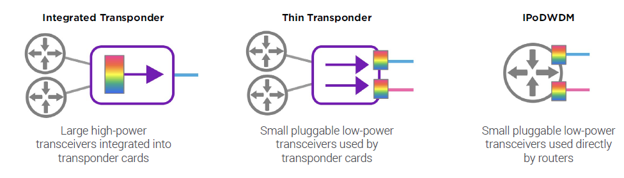
Optical Freedom in the Age of AI: Why Thin Transponders Are Reshaping Optical Network Design dedmonds Tue, 07/21/2026 - 10:18 AI is driving the next wave of digital transformation, but it is also creating an unexpected challenge for network operators: optical capacity is becoming a strategic bottleneck.The same AI boom fueling billions of dollars in data center investment is placing unprecedented demand on optical networking infrastructure. New facilities are appearing far beyond traditional hyperscale hubs, traffic patterns are becoming more distributed, and supply chain pressures are making it harder to secure the optical components needed to keep pace. In this environment, traditional single-vendor transport models can limit both flexibility and growth.Forward-thinking operators are responding with a different approach. By embracing open optical networking, coherent pluggables, and thin transponder architectures, they are gaining the freedom to choose suppliers, optimize deployments, and scale networks faster than ever before. The result is a new era of Optical Freedom—one where openness becomes a competitive advantage and flexibility becomes the foundation for AI-era growth.The Original Vision of Open Optical NetworksThe concept of disaggregated optical networking emerged from a simple industry goal: allowing multiple optical subsystems based on open and standardized interfaces to be combined into complete solutions. This approach promised several important benefits, including best-of-breed innovation, freedom from vendor lock-in, and independent technology evolution across different network layers.As open networking matured, operators realized that the advantages extended beyond architecture. Open optical networks could reduce capital costs, lower power consumption, simplify network design, and enable more flexible scaling. At the same time, multi-vendor sourcing improved supply chain resilience while multilayer visibility improved operational control.The Pluggable Revolution Has ArrivedPerhaps the biggest catalyst behind this transition is the rapid advancement of coherent pluggable optics. Historically, high-capacity optical transport relied on large proprietary modules designed for integrated transport platforms. Today, compact pluggable technologies are expanding into higher capacities and longer reaches while maintaining lower power consumption.Industry projections show pluggable optics representing a significant majority of coherent optical equipment ports throughout the remainder of the decade.This transformation is creating what many refer to as "optical freedom"—the ability for operators to source optical pluggables from multiple suppliers rather than being tied to a single equipment vendor. Multi-vendor pluggable ecosystems provide flexibility during supply constraints while fostering pricing competition and technology choice.Enter the Thin TransponderThin transponders occupy a middle ground between traditional integrated transport systems and direct router-based coherent networking. Instead of embedding high-power optics inside proprietary transport shelves, thin transponders leverage smaller pluggable coherent optics while maintaining many of the operational benefits of dedicated optical transport platforms. <img alt="alt" class="img-responsive" height="178" src="https://ribboncommunications.com/sites/default/files/thin-transp
Optical Freedom in the Age of AI: Why Thin Transponders Are Reshaping Optical Network Design dedmonds Tue, 07/21/2026 - 10:18 AI is driving the next wave of digital transformation, but it is also creating an unexpected challenge for network operators: optical capacity is becoming a strategic bottleneck.The same AI boom fueling billions of dollars in data center investment is placing unprecedented demand on optical networking infrastructure. New facilities are appearing far beyond traditional hyperscale hubs, traffic patterns are becoming more distributed, and supply chain pressures are making it harder to secure the optical components needed to keep pace. In this environment, traditional single-vendor transport models can limit both flexibility and growth.Forward-thinking operators are responding with a different approach. By embracing open optical networking, coherent pluggables, and thin transponder architectures, they are gaining the freedom to choose suppliers, optimize deployments, and scale networks faster than ever before. The result is a new era of Optical Freedom—one where openness becomes a competitive advantage and flexibility becomes the foundation for AI-era growth.The Original Vision of Open Optical NetworksThe concept of disaggregated optical networking emerged from a simple industry goal: allowing multiple optical subsystems based on open and standardized interfaces to be combined into complete solutions. This approach promised several important benefits, including best-of-breed innovation, freedom from vendor lock-in, and independent technology evolution across different network layers.As open networking matured, operators realized that the advantages extended beyond architecture. Open optical networks could reduce capital costs, lower power consumption, simplify network design, and enable more flexible scaling. At the same time, multi-vendor sourcing improved supply chain resilience while multilayer visibility improved operational control.The Pluggable Revolution Has ArrivedPerhaps the biggest catalyst behind this transition is the rapid advancement of coherent pluggable optics. Historically, high-capacity optical transport relied on large proprietary modules designed for integrated transport platforms. Today, compact pluggable technologies are expanding into higher capacities and longer reaches while maintaining lower power consumption.Industry projections show pluggable optics representing a significant majority of coherent optical equipment ports throughout the remainder of the decade.This transformation is creating what many refer to as "optical freedom"—the ability for operators to source optical pluggables from multiple suppliers rather than being tied to a single equipment vendor. Multi-vendor pluggable ecosystems provide flexibility during supply constraints while fostering pricing competition and technology choice.Enter the Thin TransponderThin transponders occupy a middle ground between traditional integrated transport systems and direct router-based coherent networking. Instead of embedding high-power optics inside proprietary transport shelves, thin transponders leverage smaller pluggable coherent optics while maintaining many of the operational benefits of dedicated optical transport platforms. <img alt="alt" class="img-responsive" height="178" src="https://ribboncommunications.com/sites/default/files/thin-transp
IPoDWDM Router Solutions: A Modern Approach to Network Architecture dedmonds Fri, 07/10/2026 - 13:48 The relentless growth of data traffic, driven by cloud services, high-speed residential broadband, 5G mobility, and enterprise digitalization, places enormous pressure on network infrastructure. Service providers and large enterprises must scale capacity while simultaneously controlling costs and reducing operational complexity. In this environment, traditional network architectures are reaching their breaking point, creating an urgent need for a more efficient and integrated approach to transport.IP over Dense Wavelength Division Multiplexing (IPoDWDM) has emerged as a transformative technology that directly addresses these challenges. By integrating optical components into routing platforms, IPoDWDM collapses networking equipment, streamlines operations, and delivers substantial economic benefits. This approach represents a fundamental shift in how networks are designed, built, and managed.What is IPoDWDM?IPoDWDM is a network architecture that integrates coherent Dense Wavelength Division Multiplexing (DWDM) optics directly into routers and switches. This eliminates the need for dedicated, standalone optical transponder shelves that have historically been required to connect the IP routing layer with the underlying optical transport network.By embedding technologies like 400G ZR+ pluggable optics into routing platforms, a single device can now perform both IP/MPLS routing and high-capacity optical transmission. The router itself becomes the source of the colored wavelength, collapsing two distinct sets of network equipment into one. As a result, the network becomes simpler, more efficient, and more cost-effective to operate. This integration is the core principle of IPoDWDM.How Does IPoDWDM Reduce Network Complexity?IPoDWDM dramatically simplifies network architecture and operations by collapsing the IP and optical networks into a single, unified domain. In a traditional multi-layer design, network teams must manage separate IP routing equipment and optical transport systems, each with its own hardware, control plane, and management software.This separation creates significant operational friction. Provisioning a new service requires coordination across multiple teams and systems, increasing both time and the potential for error. By eliminating the separate transponder network, IPoDWDM removes an entire set of network elements. This consolidation results in fewer devices to procure, install, and manage; a single control plane for routing and transport; and a streamlined operational workflow. The ultimate outcome is a more agile and responsive network with a significantly lower operational burden.What Are the Primary Cost Benefits of IPoDWDM?The primary financial benefit of adopting IPoDWDM is a substantial reduction in Total Cost of Ownership (TCO). This is achieved through direct savings in both Capital Expenditures (CapEx) and Operational Expenditures (OpEx).From a CapEx perspective, eliminating separate transponder shelves and their associated hardware directly reduces initial equipment costs. The network requires fewer physical boxes to achieve the same function. The OpEx savings are even more profound. Fewer devices mean a smaller physical footprint, which in turn reduces power and cooling costs by as much as 70%. Furthermore, the operational s
IPoDWDM Router Solutions: A Modern Approach to Network Architecture dedmonds Fri, 07/10/2026 - 13:48 The relentless growth of data traffic, driven by cloud services, high-speed residential broadband, 5G mobility, and enterprise digitalization, places enormous pressure on network infrastructure. Service providers and large enterprises must scale capacity while simultaneously controlling costs and reducing operational complexity. In this environment, traditional network architectures are reaching their breaking point, creating an urgent need for a more efficient and integrated approach to transport.IP over Dense Wavelength Division Multiplexing (IPoDWDM) has emerged as a transformative technology that directly addresses these challenges. By integrating optical components into routing platforms, IPoDWDM collapses networking equipment, streamlines operations, and delivers substantial economic benefits. This approach represents a fundamental shift in how networks are designed, built, and managed.What is IPoDWDM?IPoDWDM is a network architecture that integrates coherent Dense Wavelength Division Multiplexing (DWDM) optics directly into routers and switches. This eliminates the need for dedicated, standalone optical transponder shelves that have historically been required to connect the IP routing layer with the underlying optical transport network.By embedding technologies like 400G ZR+ pluggable optics into routing platforms, a single device can now perform both IP/MPLS routing and high-capacity optical transmission. The router itself becomes the source of the colored wavelength, collapsing two distinct sets of network equipment into one. As a result, the network becomes simpler, more efficient, and more cost-effective to operate. This integration is the core principle of IPoDWDM.How Does IPoDWDM Reduce Network Complexity?IPoDWDM dramatically simplifies network architecture and operations by collapsing the IP and optical networks into a single, unified domain. In a traditional multi-layer design, network teams must manage separate IP routing equipment and optical transport systems, each with its own hardware, control plane, and management software.This separation creates significant operational friction. Provisioning a new service requires coordination across multiple teams and systems, increasing both time and the potential for error. By eliminating the separate transponder network, IPoDWDM removes an entire set of network elements. This consolidation results in fewer devices to procure, install, and manage; a single control plane for routing and transport; and a streamlined operational workflow. The ultimate outcome is a more agile and responsive network with a significantly lower operational burden.What Are the Primary Cost Benefits of IPoDWDM?The primary financial benefit of adopting IPoDWDM is a substantial reduction in Total Cost of Ownership (TCO). This is achieved through direct savings in both Capital Expenditures (CapEx) and Operational Expenditures (OpEx).From a CapEx perspective, eliminating separate transponder shelves and their associated hardware directly reduces initial equipment costs. The network requires fewer physical boxes to achieve the same function. The OpEx savings are even more profound. Fewer devices mean a smaller physical footprint, which in turn reduces power and cooling costs by as much as 70%. Furthermore, the operational s
What Is Coherent Routing? dedmonds Tue, 06/16/2026 - 11:29 Coherent routing, Routed Optical Networking, Converged Optical Routing Architecture (CORA), are all names for the same concept: an advanced network architecture which integrates coherent optical transceivers directly into IP routers. This convergence of layers creates a simplified and highly efficient IP-over-DWDM (IP over Dense Wavelength Division Multiplexing) network.By embedding optical transmission capabilities within the routing platform, operators can strategically collapse redundant hardware, reducing network complexity and cost without sacrificing the flexibility of a symbiotic IP and optical architecture.This approach marks a significant evolution from traditional network designs where IP routing and optical transport were managed as distinct, separate domains. Consequently, coherent routing enables a more streamlined, scalable, and automated infrastructure prepared for modern traffic demands.What Are Its Key Components?The architecture relies on three fundamental components working in unison to deliver a converged IP and optical solution.Coherent Pluggable Optic: Compact, standards-based modules, such as 400GZR+, that contain the DSP and optical components. They plug directly into compatible router ports, enabling high-capacity optical transmission.IP Routers with Integrated Optics Support: Routing platforms designed to support coherent pluggables, including power, cooling, and software integration for monitoring and control. Ribbon’s NPT 2714 is an example.Optional: Pluggable Amplifier: A QSFP-DD module that boosts optical signals to extend transmission range.Optional: Optical Line System (OLS): Includes mux/demux and amplifiers to combine wavelengths and extend distance.How Does Coherent Routing Compare to Traditional Approaches?MetricCoherent RoutingTraditional Routing (with Transponders)ArchitectureIP Routing + Optical LayersSeparate IP and Optical LayersCapacity400G+ Coherent OpticsTypically 10G/100G (gray optics)ComplexityReduced; fewer network elementsHigher; separate router and transponder managementPower & SpaceLower footprint and consumptionHigher footprint and consumptionWhat Are the Primary Benefits of Coherent Routing?The primary benefits include reduced network complexity, lower total cost of ownership, and increased operational agility.Reduced Total Cost of Ownership (TCO): Eliminates transponder hardware, reducing CapEx, power consumption, and physical footprint.Simplified Network Architecture: Fewer elements make the network easier to plan, deploy, and manage.Increased Scalability and Capacity: Enables fast deployment of 400G services on existing infrastructure.Enhanced Operational Automation: A unified network simplifies automation using platforms like Ribbon Muse.Why Is IP and Optical Convergence Important?Convergence is essential for creating a service-aware, efficient, and automatable transport network.Historically, IP and optical layers operated as separate silos, leading to inefficiencies and underutiliz
What Is Coherent Routing? dedmonds Tue, 06/16/2026 - 11:29 Coherent routing, Routed Optical Networking, Converged Optical Routing Architecture (CORA), are all names for the same concept: an advanced network architecture which integrates coherent optical transceivers directly into IP routers. This convergence of layers creates a simplified and highly efficient IP-over-DWDM (IP over Dense Wavelength Division Multiplexing) network.By embedding optical transmission capabilities within the routing platform, operators can strategically collapse redundant hardware, reducing network complexity and cost without sacrificing the flexibility of a symbiotic IP and optical architecture.This approach marks a significant evolution from traditional network designs where IP routing and optical transport were managed as distinct, separate domains. Consequently, coherent routing enables a more streamlined, scalable, and automated infrastructure prepared for modern traffic demands.What Are Its Key Components?The architecture relies on three fundamental components working in unison to deliver a converged IP and optical solution.Coherent Pluggable Optic: Compact, standards-based modules, such as 400GZR+, that contain the DSP and optical components. They plug directly into compatible router ports, enabling high-capacity optical transmission.IP Routers with Integrated Optics Support: Routing platforms designed to support coherent pluggables, including power, cooling, and software integration for monitoring and control. Ribbon’s NPT 2714 is an example.Optional: Pluggable Amplifier: A QSFP-DD module that boosts optical signals to extend transmission range.Optional: Optical Line System (OLS): Includes mux/demux and amplifiers to combine wavelengths and extend distance.How Does Coherent Routing Compare to Traditional Approaches?MetricCoherent RoutingTraditional Routing (with Transponders)ArchitectureIP Routing + Optical LayersSeparate IP and Optical LayersCapacity400G+ Coherent OpticsTypically 10G/100G (gray optics)ComplexityReduced; fewer network elementsHigher; separate router and transponder managementPower & SpaceLower footprint and consumptionHigher footprint and consumptionWhat Are the Primary Benefits of Coherent Routing?The primary benefits include reduced network complexity, lower total cost of ownership, and increased operational agility.Reduced Total Cost of Ownership (TCO): Eliminates transponder hardware, reducing CapEx, power consumption, and physical footprint.Simplified Network Architecture: Fewer elements make the network easier to plan, deploy, and manage.Increased Scalability and Capacity: Enables fast deployment of 400G services on existing infrastructure.Enhanced Operational Automation: A unified network simplifies automation using platforms like Ribbon Muse.Why Is IP and Optical Convergence Important?Convergence is essential for creating a service-aware, efficient, and automatable transport network.Historically, IP and optical layers operated as separate silos, leading to inefficiencies and underutiliz